Posts

The 36th Launceston Trial 2022

Image
Team Robson with their Rickman Ranger and Graham Beddoe at the start of the 35th Launceston Trial For Graham Beddoe and me, today’s Launceston Trial was a trial of two halves. Before lunch we seemed to be lacking grip. After some post Exeter Trial fettling, the Arkley-MG felt soft on the rear during the drive to the venue in Lew Woods. The weather conditions were ideal but the mud was not to my taste. It was frequently deep and not very liquid, often taking on the consistency of modelling clay. The mud filled the cleats of the Arkley-MG’s tyres, front and rear. The front end could wash out and, if I throttled back to get the front tyres to bite, I struggled to get going again. This was a surprise because the Radar Dimax Classics on the rear had acquitted themselves well on the Exeter in January, despite taking a beating. The conditions then had been much wetter and we weren't in Lew Woods.... We began well with Zak’s Track, which turned this way and that throughout the trees. T...
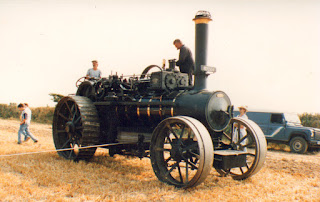
Firedrake files no.11 - Hero, the McLaren ploughing engine

Image
Bereaved twin  Hero  in between pulls of the plough My mother was a twin to my Auntie Margaret. They might have been identical twins although I could always tell them apart.  They identified with ploughing engines built in pairs. One was built to winch from the left and the other winched from the right. With a friendly amount of whistling between the two, they would shuffle forward gradually along the field, speeding the plough between them. Hero pulls from the right hand side with its secondhand Fowler cable drum Ploughing was heavy work so the boilers were big and the cylinders of the engine equally massive. Their wheels were wider than other engines to spread their weight over soft ground. Overall, ploughing engines had a greater physical presence compared to other traction engines. My mother and aunt often said it was the plainness of these huge engines appealed. I don't think they personally identified with that plainness. It was the twinship they liked and the mass...

Vintage Thing No. 159 - Imhof Mk1 Special

Image
Long before I ever became a Candid Provocateur, I stumbled across the Imhof Special. One of my best friends at school gave me The Book of the Motor Car , published in 1952 by The Naldrett Press Ltd and approved by the Society of Motor Manufacturers and Traders, no less. My favourite chapter was Building Your Own Car by A Godfrey Imhof, in which our hero made a competition car out of parts of Ford 10 and Austin 7 gleaned from scrapyards. HRK55 was the first version of the Imhof special as described in The Book of the Motor Car   (Photo : Naldrett Press) Who couldn't be inspired by such Boy's Own DIY initiative? I later discovered that this A Godfrey Imhof was actually the Godfrey Imhof, or Goff Imhof, one of the original Candidi Provocatores who’d raced Singers before the Second World War prior to rallying and trialling Allards in the immediate post war period. He built the Imhof Special using his experiences of trialling the big V8 sidevalve engine cars and ushered in a new ...

Vintage Thing no.57.1 - Little Jimmy

Image
English by looks but rear-engined in nature (Photo : Saco) When I wrote about Little Jim in my original post , there was a conspicuous gap in the narrative. Some details about the pre-war Little Jim were known to me but the next prototype for a very small car for the Rootes group was even more mysterious. All we had to go on was a mention in the Henshaw's book about the Hillman Imp,  Apex - The inside story of the Hillman Imp. This, of course, was the eventual flowering of the small car concept developed by Rootes. In the Henshaw's book, Little Jimmy i s described as rear-engined and powered by a two-cylinder version of a Volkswagen air-cooled motor. These pictures of Little Jimmy popped up on the Auto Puzzles website in 2014 and eventually appeared via a link on the Imp Club Facebook page. What's that coming over the hill? (Photo : Grobmotorix archive) It took a while for the puzzle to pan out. By a process of elimination, the Rootes group were eventually identified and C...

Vintage Thing No. 158 - Skeetle

Image
  It all looks so innocent At the 1999 MCC Testing Trial, I took these photos of a Skoda convertible with a difference. These are rare cars and getting rarer but this car was unique. It was based on a VW Beetle chassis. Beetle chassis have much to recommend them and during the sensational seventies many manufacturers used them as the basis for their exotic kit cars. The Nova and Eagle spring to mind. There were many lesser known ones like the Centron and the Car with No Name . The obvious thing to do, to counterpoint all those exotic faux supercars, was to mount a convertible Skoda bodyshell on a Beetle chassis and go trialling with it. This is the Skeetle built by Dave Nash. Dave built a series of trials specials on Beetle floorpans, which used MGB and Reliant Scimitar GTE bodyshells as well as this one with a Skoda body. Beetles and Skodas have a great deal of trialling heritage so combining them in this way seemed to be an innovation that would be assured of immediate success....

Vintage Thing No.157 - Vat 69

Image
VAT 69 caught my eye in the car park of our hotel after the 2022 Exeter Trial The 92nd Exeter Trials people's choice for Spirit of the Event went to Hughie Walker and Angus Frost with their Austin 7 special VAT 69. Their climb up Simms was a tremendous crowd pleaser and finishing one of the wettest Exeters in a machine without roof, doors, sides and windscreens was nothing short of superhuman. From a distance, VAT 69 could be mistaken for a GN special that had eaten its greens. Through the trees and rain it sounded a bit like a vee twin but those cylinders are at the widest vee possible - 180 degrees. This is an engine whose barrels have fallen out. They dislike each other so much they can't be in the same engine compartment. They are horizontally opposed. That power bulge down the side is for the driver's feet I like flat twins. The layout is still relevant today in modern cars for packaging reasons. The term horizontally opposed sounds earnestly belligerent but 180 degree...

Vintage Thing No. 156 - Harmes' Bedford YRQ (Podgy's successor)

Image
Here is our old school bus after it had been sold on. Don't those mirrors look small? I found this mage on the net years ago but can't find it anywhere anymore so can't give credit for the source. (Photo: TBC) Once I was old enough to go to secondary school in Newquay, I had to walk ¾ mile out of the valley up to Penhallow on the A3075. Here I caught a white and orange bus operated and driven by Bussy. His real name was Peter Harmes and he had a hotel in Newquay. While kids in Perranporth came to Newquay on green Western National double deckers, usually Bristol Lodekkas, the smaller villages inland were served by Bussy and his Bedford YRQ with Willowbrook Expressway coachwork. This coach was more of a bus really and nowhere near as glamorous as the delightful Podgy , a Duple Yeoman-bodied Thames Trader operated by Mitchell's of Perranporth, hich took us to primary school in Gonhavern. It wasn't even sign written.  FAF987L seated 45 and was and supplied n...